Thursday, January 26, 2012

Woad Dye

Just found out about this medieval dye from France being revived and marketed in products by Bleu de Lecture.  French blue was in vogue way  before the aniline  mauve craze of the industrial era. Woad is plant based and looks to be a good alt for indigo (which crocks). This will add to the range of naturally sane blue colored possibilities.


The video from Des Racines et Ailes. is lovely and informative, even if you don't speak French  

photo credit: workshops from botanical colors, 
Woad Dye and Denise Lambert of Bleu de Lectoure

More on natural dyes at Botanical Colors. 

Wednesday, January 25, 2012

the light goes on

and on. Check out the latest universal light shows at http://apod.nasa.gov/apod/ap120124.html
This post is to remind us that we are born of Stars (The Living Universe, Elgin) and that we are the light with the power necessary to change the way poor perceptions have  misguided life. It is also the year of the dragon, wow all this magick is now!!
photo by Bjørn Jørgensen/NASA (Grotfjord, Norway - 1/23/12).

Friday, January 13, 2012

Shame on US

Tris is back, though banned in 1977 for use in children's pajamas, it is now turning up on changing tables, car seats and other foam filled infant products.

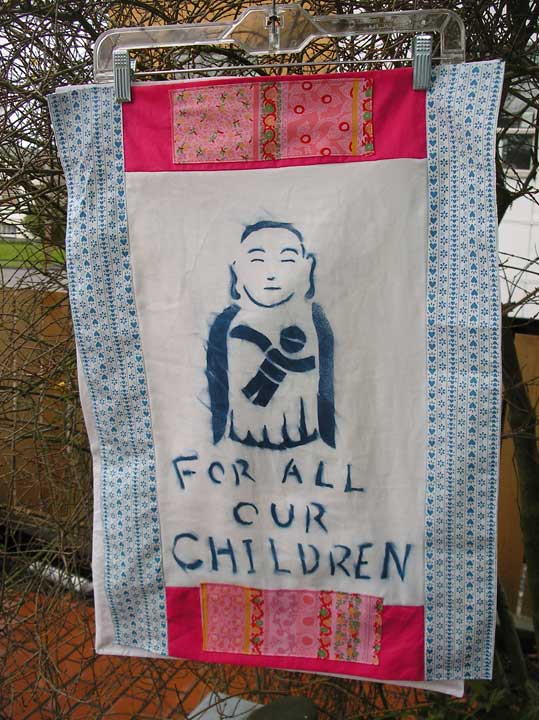
banner for occupy seattle (occupy chaplains) 
stencilled panel by michael, fabric border finish  by djb

Flame retardants are chemicals meant to protect us, but once again the "cure" is might be worse than the disease. The effectiveness of flame reatarding toxins is being questioned but the health consequences of this body of  "halogenated flame retardants – those containing bromine or chlorine – can cause endocrine disruption, immunotoxicity, reproductive toxicity, cancer, and adverse effects on fetal and child development and on neurologic function."

Toxic flame retardants found in many foam baby products


Thursday, January 5, 2012

Common Threads Initiative


Patagonia, has launched an EBay shop for their used gear and garments. With headings : Reduce, Repair, Reuse, Recycle, Reimagine.

According to ecouterre, "Patagonia created a virtual swap meet on Wednesday for buying and selling used Patagonia gear—an unexpected retail model that’s a first for a major brand.......

The Common Threads Initiative addresses a significant part of today’s environmental problem: the footprint of our stuff,” says Yvon Chouinard, Patagonia’s founder and owner. “This program first asks customers to not buy something if they don’t need it. If they do need it, we ask that they buy what will last a long time—and to repair what breaks, reuse, or resell whatever they don’t wear any more. And, finally, recycle whatever’s truly worn out.”

Not only will Patagonia be putting used clothes back into circulation, but it also won’t profit from any of the transactions.

The program is groundbreaking for several reasons. Not only will Patagonia be putting used clothes back into circulation, which could cannibalize new sales, but it also won’t profit from any of the transactions. Patagonia, Chouinard adds, is the first company to ask its customers to take a formal pledge to reduce consumption and keep products out of the landfill or incinerator."

Sunday, December 25, 2011

Bluebird for Happiness


Aqua flocked organdy, fiber collage
for my granddaughters.


Welcoming the New Year

Wednesday, December 21, 2011

Kids Killer Klothes


"Ask your legislator to support the Toxic-Free Kids Act! The Toxic-Free Kids Act will be introduced in January, but we need to get the word out now. Why? Because we don’t want cancer-causing flame retardants in our children’s products and we need companies to stop replacing one toxic chemical with another in products made for kids.

The Toxic-Free Kids Act will get cancer-causing Tris Flame Retardants out of baby products and encourage companies to switch to safer chemicals that won't harm health, the environment, or their bottom line. Tris flame retardants are especially concerning because they can cause cancer. One was even removed from kids pajamas in the 70s because of health concerns but now it’s back, and we need to get it out of our homes and away from our kids."

This is a message from Washington Toxics
Coalition, in the hope that we as a people will start taking back our responsibility for the well being of life on this little planet, we call home.

I am for a "Sanity Act" as there is no rational excuse I can find to not freak at what our "leaders" have allowed. In the name of commerce we as a species have been duped into a suicidal trance of sugars, fats and seductive virtual worlds.

The manmade processed, patented, promoted for profits reality lost it's human purpose. What have we become and why is it so much less than our true possibility.?

Tuesday, December 13, 2011

possibility

the chicken stopped to ponder possibilities before crossing the road.
Ballard metal art on 57th and 14th

When faced with an opposition, ask yourself or others what might be another possibility? It is so easy to see the "is" that we fail to realize that it is only an appearance of one of many possible alternatives. What may look to be anger may be pain. What is a rule may have a good way around it. What was useful once, may no longer be applicable.

Wednesday, December 7, 2011

Broken

digitally enhanced re-used envelope
collage/marker illustration


"The U.S. chemical regulatory system is broken and fails to protect people, wildlife and the environment from toxic chemical exposures." (Washington Toxics Coalition)

Flame retardants (PBDEs) in clothing and household furnishings, carpet padding, televisions -the list is long make your haven a hazardous site.

"PBD
Es are a family of chemicals used as flame retardants in our everyday lives. They accumulate and are long lasting, and we are concerned about them because they have been known interfere with proper thyroid function in laboratory animals, cause problems with brain development, and disrupt learning, memory and behavior.

When there is a fire, seconds are precious and flame retardants can save lives. However, many alternatives are available which are safer. Governments which have passed PBDE bans recognize those alternatives and are choosing to protect fire fighters, children and all citizens from harmful toxic chemicals by encouraging safe alternatives." Safer States

Friday, December 2, 2011

Fashion? Where?

Illustration with marker, re-purposed envelopes
on paper. 2011 djb

I am out of love with fashion.

I have been wondering if it was just me and my jaded vision or if there was more to it. There is more.

Designers are being killed They are dying in the process of business over art, function and aesthetics When business dominates art, it ruins the best of it. Like the goose who laid the golden eggs, when designers are pushed to produce too much, too fast, there is burn out and whole, fully developed, lifecycle potentials are squashed. This is sad all around.

Fashion got boring because sales glut, trend pushing, fast fashion laws of profit have fouled the scene. Chanel designed for lifestyle changes. She created clothing for bobbed, indie women. The clothing followed the cultural changes.

Now designs are made for corporate bottom lines. That speaks to another cultural change. This change destroys more than it needs and gives back as little as possible. It wants volume and is always hungry. This is against the law of nature and is therefore very dangerous.

The antidote is to buy from local independent designers, exchange and swap and/or re-fashion and re-style clothing yourself or hire a pro refashionist. All of this will better support your local economy and that is a good thing.

Occupy is about the abuse. Creating the alternative economies that enhance creativity, diversity and healthy well being can start with your next purchase. Be mindful and we will get through this and into the new dawning.

be well.

Tuesday, November 15, 2011

Future Fabrics

waiting for the lightrail in Tacoma

Future Fabrics Expo November 29th and 30th at the London College of Fashion. Attend if you can if you are not heading to UK soon, then keep a look out for sustainable textiles stateside. Take the list in to your fabric store and ask them if they know where you can find these new textiles and why we are not supporting the products that actually tell our young people we care about them and their futures.

"Fabrics shown will include, amongst others

- recycled ‘paper leather’ (PAper No.9)

- coffee waste (SCafe),

- recycled polyester (worrisome what with the breakdown to micro sized particles flushed into the oceans and ending up in food webs)

- waste banana fibre,

- sustainable man made fibres derived from trees and plants.


These will be shown alongside fabrics made with

- sustainably produced natural fabrics which include locally sourced and recycled wool,

- organic and low impact silk,

- a diverse range of woven, ribbed, printed and blended organic cotton

- hemp and linen fabrics

- and dozens of others."

Ask for the world you want and please ask others to ask too!

Thursday, November 3, 2011

Seaweed Ink

Seaweed dyes have been used for awhile now but as an alternative to screen print ink, we can thank GreenWear for using it on organic tees

Nice.

Thursday, October 27, 2011

Microscopic Synthetics at Sea


Microscopic synthetic fibers, especially polyesters and acrylics, are winding up on beaches worldwide. Scientists believe they are being released into the environment via washing machines and sewer lines.

According to the 11/1 issue of Environment Science and Technology, "microplastics" are defined as plastic particles "smaller than 1 nanometer—or one hundred-thousandth the width of a human hair." These particles are raising health and safety concerns as they have been found washed up on shorelines around the world and something that small will invariably end up in the food web.

Super filtered washing machines (product refashion for new greener machines, $$$) might help relieve this problem (a little), however, isn't it time we stopped allowing "the market" to rule our combined destinies? Isn't it time we started going to the source of problems and not just look to the profitable "relief of symptoms?" Isn't it time while we still have time?

Stopping the madness means we stop allowing the manufacture of fibers that are causing who knows what, as they circulate through the natural systems. These are the aliens we need to fear.

The total toxic waste and chemical evidence is alarming and it is ethically intolerable to continue exposing life to things we will not and actually cannot take full responsibility for. Take the money and run is no longer an option, where ya gonna run to?

As for now, consumers can choose natural fibers over synthetics and look to hemp, organic fair trade cotton, some bamboo, ethical silk, eco sane processed wool, more.

Note: The recycled plastic "cure" isn't. Polyester fleeces (the "new" oil byproduct and the recycled plastic bottle "eco " fleeces) "can release up to 180 percent more fibers than other textiles."

Info from Ec0uterre article by Amanda Coen. Faux eco and green wash are everywhere, as old skool capitaization ( new school see Ellen Brown for ideas!!)process tries to maintain its parasitic hold on the planet and its inhabitants.